
CNC Machining Design Guidelines
Practical DFM guidelines to help engineers improve part manufacturability, choose appropriate tolerances, and reduce machining costs.
Design Guidelines for CNC Machining
Key recommendations to help you design high-quality, cost-efficient CNC machined parts.
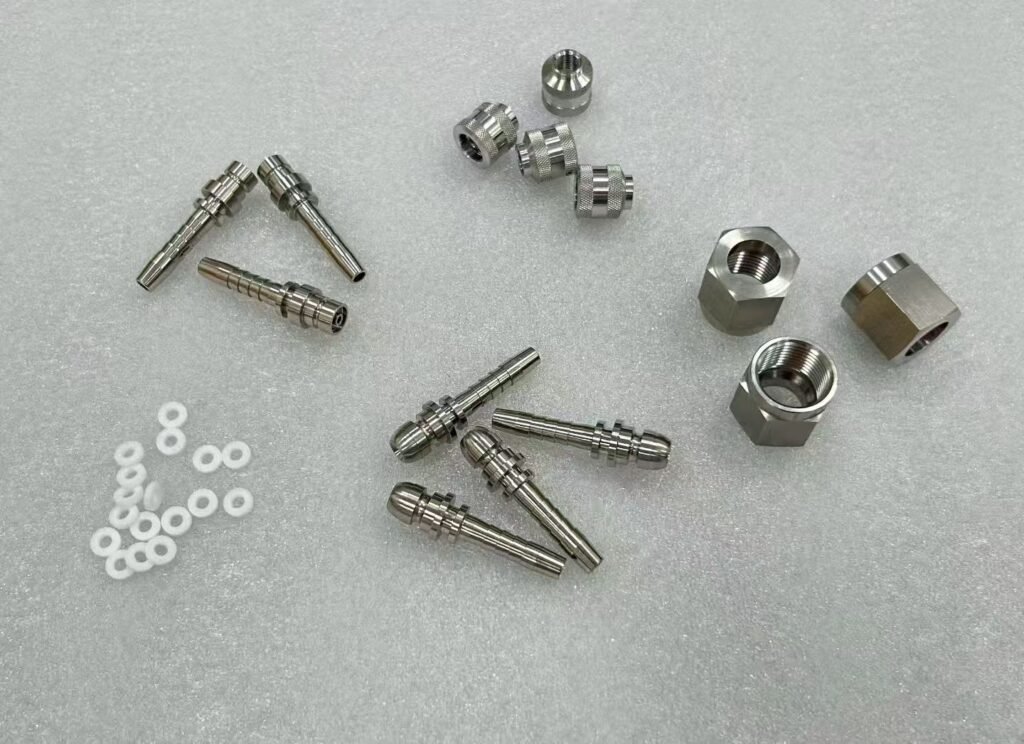
Tolerance Design
- Apply tight tolerances only to critical and mating features.
-
Use standard tolerances for non-critical dimensions (e.g., ISO 2768-m).
Design Tip: Define functional tolerances based on assembly and performance needs.
Wall Thickness
-
Maintain adequate wall thickness to avoid vibration and deformation.
-
General reference: ≥ 0.8 mm for metals (≥ 1.5 mm recommended) and ≥ 1.5 mm for plastics.
Design Tip: Add ribs or gussets for strength instead of increasing overall thickness.
Holes & Threads
- Use standard drill sizes and avoid non-standard dimensions.
-
Thread depth of 1.5× to 3× the nominal diameter is typically sufficient.
Design Tip: Avoid unnecessarily deep threads to reduce tap breakage risk and cost.
Internal Corners & Radii
- Avoid sharp 90° internal corners.
-
Add a radius (e.g., R ≥ 1/3 of cavity depth) for better tool access and part strength.
Design Tip: Use larger radii when possible to improve tool life and surface finish.
Undercuts & Tool Access
- Avoid undercuts that require special tools (e.g., T-slot or lollipop cutters).
-
Ensure sufficient tool access and clearance for deep or narrow features.
Design Tip: Redesign undercuts as open features when possible to simplify machining.
Material Selection
- Choose materials based on mechanical properties, application environment, and cost.
-
Consider factors such as strength, weight, corrosion resistance, and machinability.
Design Tip: Balance performance and cost, and select readily machinable materials.
Surface Finish Considerations
- Specify the surface finish based on function and appearance.
-
Common as-machined finish: Ra 3.2 μm (125 μin).
- Use smoother finishes (e.g., Ra 1.6 or 0.8 μm) for sealing or visible surfaces.
Design Tip: Avoid over-specifying surface finishes to keep costs under control.
Design for 5-Axis
- Ideal for complex geometries, multi-face features, and curved surfaces.
-
Can reduce setups, improve accuracy, and maintain consistent feature relationships.
Design Tip: Consider 5-axis machining for parts with multiple angled or freeform features.
How to Reduce CNC Machining Costs
Simple design tweaks that can significantly lower cost.
Minimize Setups
Design for fewer setups (e.g., 5-axis or multi-side machining).
Avoid Undercuts
Use open and machinable features to reduce special tooling.
Relax Non-Critical Tolerances
Apply standard tolerances (e.g., ISO 2768-m) to non-critical dimensions.
Standardize Surface Finish
Use an as-machined finish (Ra 3.2 μm) for most features and smoother finishes only when needed.
How to Specify CNC Machining Tolerances
Design guidance for setting practical and cost-effective tolerances.
| Design Requirement | Recommendation |
|---|---|
| General Dimensions | Use reasonable tolerances (e.g., ISO 2768-m) for non-critical features. |
| Mating Features | Specify tighter tolerances based on fit and function (e.g., ±0.01–0.02 mm). |
| Critical Features | Clearly identify critical dimensions on drawings (e.g., bore, shaft, sealing surfaces). |
| Geometric Tolerances | Apply GD&T (e.g., flatness, perpendicularity, position) only where functionally necessary. |
Frequently Asked Questions
Quick answers about DFM reviews, CAD files, and CNC design optimization.
Do you offer DFM feedback when we submit CAD files?
Yes. We review part designs for manufacturability and provide recommendations on tolerances, geometry, and material selection when needed.
What CAD formats are best for a DFM review?
STEP or STP files are preferred for 3D models. Please also provide PDF or DWG drawings with dimensions, tolerances, and material requirements.
Can you help optimize or redesign our parts for manufacturing?
We can suggest design improvements to simplify machining, reduce costs, and improve manufacturability. Any design changes require your approval.
Does DFM review increase the cost or lead time?
Not necessarily. Early DFM review can help prevent machining issues and delays. Any changes affecting cost or lead time will be discussed in advance.
Need a DFM Review for Your CNC Parts?
Share your CAD files for a manufacturability review, design feedback, and CNC machining quote.